Autonomous Wheelchairs in Airports: Lessons from a Live DFW Airport Pilot

For years, autonomous wheelchairs have been discussed as a promising solution for airports facing growing passenger volumes, labor shortages, and increasing demand for Passenger with Reduced Mobility (PRM) services.
The challenge has never been building a wheelchair that can drive itself.
The challenge has been building one that can operate safely and reliably in one of the most unpredictable environments imaginable—a busy airport terminal filled with passengers, luggage, changing layouts, and constant movement.
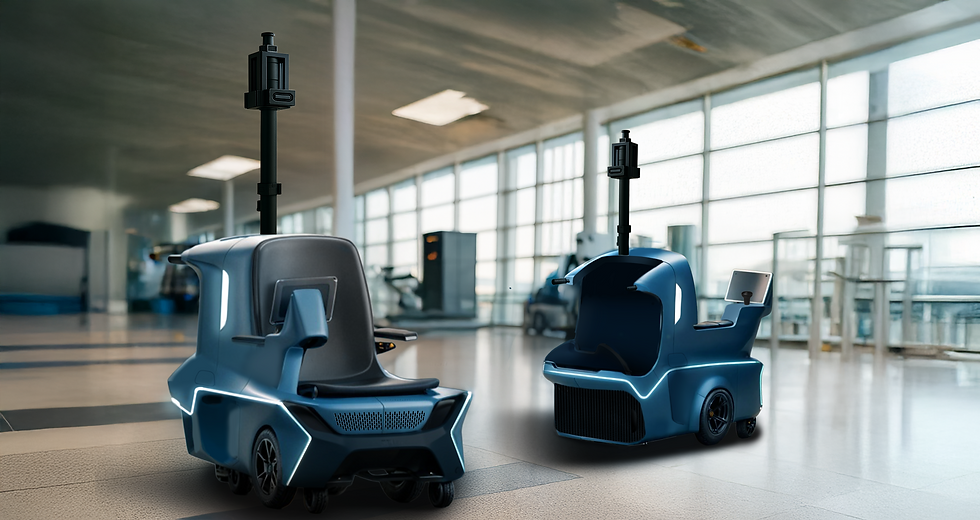
Recently, Cyberworks Robotics completed live testing of its autonomous wheelchair platform at Dallas Fort Worth (DFW) Airport, one of the world's busiest aviation hubs.
Rather than treating the pilot as a technology demonstration, the objective was simple: validate how autonomous mobility performs under real operating conditions.
Why Airports Are an Ideal Use Case for Autonomous Mobility
Airports around the world continue to experience rising demand for passenger mobility services while facing persistent staffing challenges.
Traditional wheelchair services depend heavily on human attendants, making operations expensive, difficult to scale, and vulnerable to labor shortages.
Autonomous mobility offers an opportunity to:
Improve passenger independence
Reduce operational costs
Increase service availability
Support staff rather than replace them
Deliver more consistent service quality
But only if the technology performs reliably.
Real Airports Present Real Challenges for Autonomous Wheelchair Technology
Unlike structured warehouse environments, airports are dynamic.
Autonomous mobility systems must continuously adapt to:
Dense pedestrian traffic
Narrow corridors
Families and groups walking unpredictably
Carry-on luggage and carts
Temporary construction
Varying lighting conditions
Constant changes in traffic flow
These environments leave very little room for navigation errors or unexpected behavior.
Mission-critical autonomy requires much more than simply following a map.
👉 Learn more about Mission-Critical Autonomous Mobility.
What the DFW Airport Pilot Evaluated
The recent live validation at Dallas Fort Worth Airport focused on several capabilities essential for real-world deployment.
Hallucination-Free Navigation
The pilot evaluated OmniSuite's ability to navigate complex passenger environments without unexpected autonomous behavior or edge-case anomalies requiring operator intervention.
Advanced Safety Systems
Safety remains the highest priority for passenger mobility.
The pilot validated OmniSuite's safety architecture while operating alongside real airport passengers in active terminal environments.
Crowd Navigation
Busy terminals require robots to continuously adapt to changing pedestrian movement.
The pilot demonstrated reliable navigation through crowded public spaces while maintaining predictable vehicle behavior.
Smart Manual Mode Switching
Passengers could easily transition between autonomous operation and Smart Manual Mode whenever desired, creating a flexible experience that adapts to individual comfort levels.
Predictive Maintenance & Blackbox Recording
The pilot also validated Cyberworks' onboard monitoring capabilities, including blackbox recording and predictive maintenance features that help identify anomalies before they become operational issues.
Why Live Pilots Matter More Than Lab Demonstrations
Controlled environments are valuable during development.
Operational environments determine whether autonomous mobility is commercially viable.
Every airport introduces variables that simply cannot be replicated inside a testing facility:
Passenger behavior
Peak traffic periods
Environmental complexity
Operational variability
Successful live pilots help OEMs, airport operators, and mobility providers better understand how autonomous systems perform where they will ultimately be deployed.
From Validation to Commercial Deployment: Autonomous Wheelchair at DFW Airport
Cyberworks Robotics continues working with OEM partners to accelerate deployment of autonomous mobility solutions across airports, hospitals, and other mission-critical environments.
The company's OmniSuite platform combines deterministic navigation with selective AI to deliver reliable autonomous operation while reducing OEM development time from years to weeks.
Recent collaborations with companies including ASUS IoT and BlackBerry QNX further demonstrate how the platform is being integrated into commercially deployable autonomous mobility solutions.
Looking Ahead
Autonomous mobility is no longer about proving that robots can move.
The focus is now on demonstrating that they can operate safely, predictably, and continuously in environments where people depend on them every day.
Live testing at Dallas Fort Worth Airport represents another important validation step toward that goal.
As airports continue modernizing passenger services, autonomous wheelchairs have the potential to improve accessibility, operational efficiency, and the overall travel experience—provided the underlying technology is designed for mission-critical performance from the start.
Learn More About Cyberworks Robotics
Cyberworks Robotics develops mission-critical autonomous navigation software for OEMs building the next generation of autonomous mobility solutions.
Powered by OmniSuite™, our full-stack platform helps manufacturers accelerate development while delivering reliable, hallucination-free autonomous operation across airports, hospitals, industrial facilities, and defense applications.
If you're developing autonomous mobility products or exploring automation for your operations, contact Cyberworks Robotics to learn how OmniSuite can accelerate your path to deployment.


Comments