Autonomous Wheelchair Proof of Concept Pilot Report

Updated: Feb 27


Wayne Close
Director, Innovation, Compass One Healthcare
“Challenging the status quo”
Proof of Concept ~ Autonomous Wheelchair in Acute Hospital Report
Introduction
Autonomous wheelchairs represent a transformative approach to moving patients within a hospital environment. By adopting this innovative solution, healthcare providers can improve patient experience, enhance operational efficiency, and set a new standard for outpatient mobility. This investment in technology is an investment in the health, safety and satisfaction of both patients and staff.
In 2024, Cyberworks Robotics, Markham, ON introduced Compass One Healthcare to an autonomous mobility wheelchair seeking a partner to challenge the technology in the hospital environment. As a partner of North York General Hospital, Compass presented the idea of autonomous patient movement to our client, Vice President, Planning, Redevelopment and Clinical Support. With a goal to enhance patient experience and operational efficiency, we began the planning for a first-of-its-kind live proof-of-concept pilot between the Emergency Department (ED) and the Medical Imaging (MI) Department to aid in speedy patient diagnosis, increase capacity, and allow employees to focus on meaningful patient care activities.
Proof-of-Concept Pilot Planning
Route Challenges and Wayfinding Benefits. During the initial planning of the pilot, we recognized the usual patient route was congested with staff, visitors and patients. At times, high census even reduced corridors to a single lane. In the final setup, we redirected the Cyberworks wheelchair to a quieter corridor. Although longer, this path proved safer and faster. We also observed patients struggling to find Medical Imaging despite directional signage ~ highlighting another benefit of the autonomous wheelchair.
Pilot Setup and Data Collection
The pilot was conducted July 22-24, 2025, 8 a.m. - 4 p.m. During this period, thirteen suitable patients and six hospital employees trialed the wheelchair to maximize the number of trips.
The pilot occurred between the Emergency Department’s Green Zone (least acute) and the Medical Imaging Department.
The Green Zone clinical staff made the decision on which patient would utilize the autonomous wheelchair based on acuity or urgency needed. Technical representatives from Cyberworks, along with a Porter, accompanied every transport to capture key data on equipment performance, patient feedback and employee feedback. Each patient and/or family member was informed that they were participating in a pilot project exploring alternative ways to assist them in getting to their scheduled tests.
The table below highlights the data collected under each category:

Pilot Outcomes
Patient and Family Feedback
The pilot included a wide range of participants, from pre-teens accompanied by parents to seniors. One mother of a young patient shared that she appreciated how the chair not only provided her son with a ride but also guided her to the correct location. Similarly, an elderly patient reported feeling comfortable in the chair, though she preferred not to be left alone during transport. Her adult son, however, found the experience very positive and said he would be comfortable using the chair independently.
Wheelchair Functionality and Performance
The chair allows manual operation if the chair’s autonomous obstacle avoidance system is unable to get around the obstacle due to over-crowding. This is not something that all people were physically capable of or comfortable completing.
Manual Override Redesign. As a result, the manual override was redesigned to be simpler: the patient/rider now only needs to touch the joystick to switch to ‘smart’ manual mode, which includes collision avoidance.
Speed and Safety Rationale. The speed of the chair felt slow; however, it was selected for patient safety reasons to account for other hospital staff or visitors who may be rushing through the facility (pushing a stretcher, waste cart, etc.) or turning around a blind corner. The slower wheelchair speed mitigated the possibility of colliding with such fast moving obstacles. Since completion of the pilot, Cyberworks has fine-tuned the speed to be faster without compromising safety.
Spatial Requirements and System Improvements. The chair operated smoothly if there was the required 130cm to allow for turning corners and obstacle avoidance.
Staff Efficiency and Acute Care Prioritization
Case Example of Staff Redeployment. The following scenario was observed:
An ED Team Attendant was summoned to move an adolescent patient from the Green Zone to Medical Imaging. A Nurse immediately intervened and said the patient could take part in the pilot, thus freeing the Team Attendant for other tasks. When the patient arrived at Medical Imaging the pilot team saw the same Team Attendant moving a patient on a stretcher to MI.
Impact on Acute Patient Care. This is a direct example of enabling employees to focus on more acute patient care faster through the implementation of autonomous tools and equipment to complement traditional resources.
Summary
The pilot demonstrated that the technology can operate successfully in a hospital setting, both functionally and from a patient experience perspective.
Feedback from patients and families highlighted the chair’s dual value: guiding family members to destinations and providing safe transport, while also revealing the importance of supervision for some users.
Live testing identified refinements to the wheelchair and software that would enhance performance and user experience. The refinements which were made after the pilot included (a) simpler and more intuitive manual override procedure, and (b) faster speed without compromising safety.
Corridor congestion limited the use of the typical transport route, underscoring the need for backup routing and a framework to assess space suitability for autonomous equipment.
The staff in the MI Department had minimal interaction with the wheelchair for the pilot. Partially related to the congestion around MI Reception B (unable to stop/block) and the presence of the Porter to wait with the chair for the return trip. This may have been different if the pilot was after hours however the volume of patients during “typically” busy times was low.
The ED staff saw considerable value in the pilot. Because this was first of its kind in an acute hospital environment, patient selection was conservative, but staff agreed that broader acuity levels could benefit from the autonomous wheelchair. They also noted that the congestion in the corridors will likely persist and increase with patient flow pressures. One example demonstrated how the technology freed frontline staff to focus on acute patient needs while the autonomous wheelchair managed a lower-acuity transport.
Important to note:
• No Infrastructure Requirements: mobilization does not require any infrastructure changes like visual markers or Wi-Fi connectivity.
• Fleet Management Option: the technology allows for an optional remote fleet management system (more suitable for multiple devices). This was not included in the pilot.
• Post-pilot Improvements: Commercial rollout includes cosmetic design improvements to reduce the stigma of riding a “wheelchair”, navigation software enhancements to improve maneuverability, projection floor lighting to enhance safety as well as an increase in passenger load capacity to 450lb.

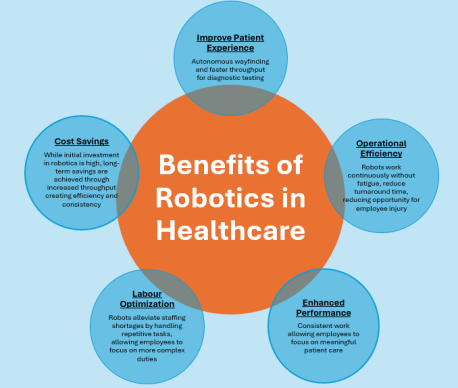
Benefits of Robotics in Healthcare and Return on Investment
Autonomous wheelchairs deliver measurable financial and operational benefits by reducing reliance on manual patient transport. In a typical hospital, one autonomous chair can displace the equivalent of a full-time porter for two shifts per day (16 hours). At an average porter wage of $25 / hr., this equates to approximately $12, 000 in monthly labour savings.
Accounting for a 20% automation efficiency loss (~$2,400), the net savings remain significant at $9,600 per month. Cyberworks aims to make technology available at a labour cost of between $2,500 and $3,500 per month on a 48-month service contract (or the equivalent one-time purchase price) depending on the volume of autonomous chairs purchased.
This yields a significant operating expense reduction from day one, while also enabling hospitals to redeploy staff for more acute and value-added tasks that directly impact patient care. The video link below highlights the route and demographics of the pilot patient / rider sampling:
Pilot Video Montage


Comments