What to Look for in an Autonomous Navigation Platform (Before You Buy)

The market for autonomous mobile robots (AMRs) is growing rapidly, from industrial transport vehicles and autonomous wheelchairs to logistics robots and smart cleaning equipment. For robotics OEMs, the challenge is no longer deciding whether to add autonomy—it's deciding how.
Many manufacturers now recognize that developing an autonomous navigation stack from scratch can delay product launches, increase engineering costs, and create long-term maintenance burdens. Instead, they're evaluating commercial autonomous navigation platforms that can accelerate development while reducing technical risk.
But not all platforms are created equal.
Some excel in controlled demonstrations but struggle in dynamic, real-world environments. Others provide navigation but leave OEMs to solve safety, diagnostics, deployment, and long-term support on their own.
If you're evaluating an autonomous navigation platform, here are the questions that matter most.

1. Does the Autonomous Navigation Platform Work Beyond Controlled Environments?
Navigation demos often take place in predictable spaces with minimal pedestrian traffic.
Real deployments are different.
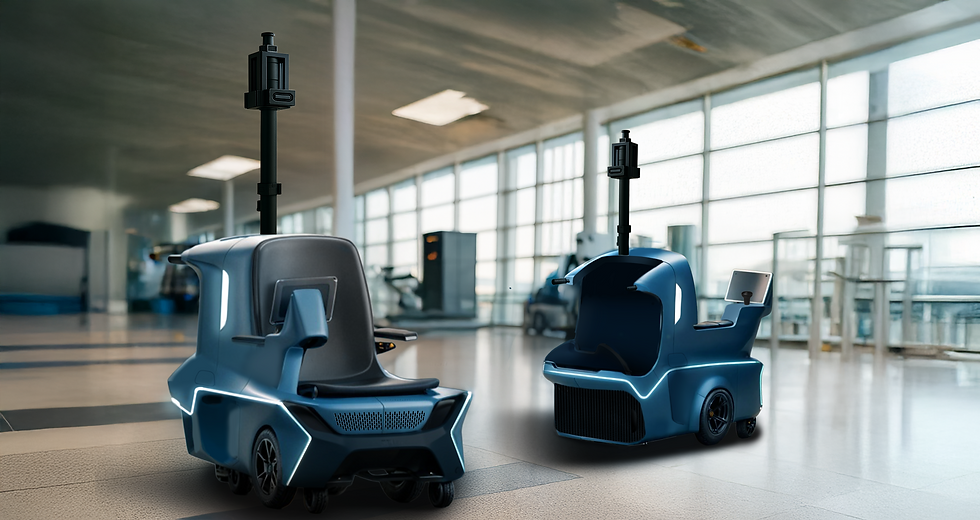
Hospitals, airports, warehouses, and industrial facilities are constantly changing. People stop unexpectedly, equipment moves without warning, and environments evolve throughout the day.
A capable autonomous navigation platform should be designed to operate reliably in dynamic environments—not just controlled demonstrations.
Ask:
Has the platform been validated in real-world deployments?
Can it navigate safely around moving people and obstacles?
How does it respond to unexpected situations?
2. How Does It Handle AI Uncertainty?
Modern robotics increasingly relies on artificial intelligence for perception and navigation.
While AI enables impressive capabilities, it can also introduce unpredictable outputs, commonly referred to as AI hallucinations.
In mission-critical applications, unpredictable behavior isn't simply inconvenient—it can become a safety risk.
Look for platforms that combine modern AI with deterministic decision-making, ensuring navigation remains predictable even when perception confidence changes.
3. Is Safety Built Into the Architecture?
Safety shouldn't exist as a separate add-on.
It should be embedded into the software architecture itself.
A mature autonomous navigation platform continuously monitors:
Sensor health
Localization quality
Motion behavior
Software integrity
System faults
Rather than relying exclusively on emergency stops, advanced platforms enforce safety continuously through supervision, motion constraints, and intelligent recovery mechanisms.
Organizations such as the International Organization for Standardization (ISO) have developed standards like ISO 3691-4 for driverless industrial trucks and mobile robots, emphasizing safe operation in shared environments.
4. Is the Autonomous Navigation Platform Hardware Agnostic?
OEMs rarely want to redesign their products around a software vendor's preferred hardware.
An effective autonomous navigation platform should integrate with a variety of:
LiDAR sensors
RGB cameras
Depth cameras
IMUs
Wheel encoders
Industrial PCs
Embedded compute platforms
Hardware flexibility gives manufacturers the freedom to optimize cost, performance, and future upgrades.
5. Does It Support Predictive Maintenance?
The best autonomous robots don't simply move.
They continuously monitor their own health.
Predictive maintenance capabilities can identify:
Sensor degradation
Battery issues
Motor performance trends
Navigation anomalies
Hardware failures before downtime occurs
This reduces service costs while improving fleet availability.
6. Can You Diagnose Problems After They Happen?
Every autonomous system should provide traceability.
A built-in Blackbox recorder captures operational data before and after system events, allowing engineers to investigate anomalies quickly.
Without this capability, diagnosing field issues often becomes slow, expensive, and inconclusive.
For OEMs deploying fleets, diagnostics are just as important as navigation itself.
7. Does It Support Remote Updates?
Robotics software continues to evolve long after deployment.
Look for platforms that support secure over-the-air (OTA) updates so new capabilities, bug fixes, and security patches can be deployed without returning robots to the factory.
OTA support also simplifies fleet management for geographically distributed customers.
8. How Much Engineering Support Is Included?
Many software vendors deliver a development kit—and stop there.
Successful deployments often require much more.
Consider:
Integration assistance
Sensor calibration
Performance tuning
Field testing
Validation support
Ongoing software updates
A platform backed by experienced robotics engineers can dramatically reduce deployment risk and accelerate commercialization.
9. Can the Platform Scale With Your Business?
Today's product roadmap may include one robot.
Tomorrow's may include five.
A navigation platform should support multiple vehicle types without requiring a complete software redesign.
Whether you're building:
Autonomous wheelchairs
Industrial transport vehicles
Cleaning robots
Defense mobility platforms
Logistics robots
…the underlying autonomy platform should remain consistent.
Scalability reduces development effort while simplifying long-term product strategy.
10. Does the Vendor Have Real Deployment Experience?
Perhaps the most overlooked question is the simplest.
Has the platform been deployed outside the lab?
Real-world deployments expose challenges that controlled demonstrations simply cannot replicate.
Crowded airports.
Busy hospitals.
Industrial environments.
Public spaces.
Platforms that have successfully navigated these environments often reflect years of engineering refinement that cannot be measured in a specification sheet alone.
How Cyberworks Robotics Approaches Autonomous Navigation
At Cyberworks Robotics, we developed OmniSuite™ as a complete autonomous mobility platform rather than a standalone navigation engine.
OmniSuite combines deterministic robotics with modern AI to deliver predictable, mission-critical autonomy across a wide range of applications.
The platform includes:
Autonomous navigation
Advanced safety supervision
Predictive maintenance
Blackbox event recording
Hardware flexibility
Over-the-air software updates
White-glove engineering support
Rather than asking OEMs to assemble multiple software components, OmniSuite provides an integrated foundation designed to accelerate commercial deployment while reducing technical risk.
Choosing the Right Autonomus Navigation Platform Is About More Than Navigation
Selecting an autonomous navigation platform isn't simply about finding software that can move a robot.
It's about choosing a technology partner capable of supporting product development from prototype through commercial deployment.
The strongest platforms combine reliable navigation with safety, diagnostics, maintainability, scalability, and long-term engineering support.
As autonomous mobility continues to expand into healthcare, airports, manufacturing, logistics, and defense, those capabilities will increasingly determine which products succeed—and which remain stuck in pilot programs.
Learn More
If you're evaluating autonomous mobility platforms for your next robotics product, explore how OmniSuite™ helps OEMs accelerate development while delivering predictable, mission-critical performance.
Visit our Solutions page to learn more, or contact the Cyberworks Robotics team to discuss your application.
Comments