Why GPUs Don't Fix Hallucinations in Robotics

The robotics industry is experiencing its own version of the AI arms race. Every year, processors become faster. GPUs become more powerful. Neural networks become larger. Yet despite all this computational progress, one problem continues to limit widespread autonomous deployment: AI hallucinations.
Many organizations assume that adding more compute will eventually solve reliability challenges.
But in robotics, reality is more complicated.
The biggest obstacle to autonomous mobility is often not a lack of intelligence.
It's a lack of predictability.
And no amount of GPU power can guarantee that.

The Industry's Obsession With More Compute
Modern autonomous systems process enormous amounts of information.
Cameras.
LiDAR.
Radar.
GPS.
Inertial sensors.
Environmental mapping data.
Machine-learning models help robots interpret this information and make decisions in real time.
Naturally, many developers assume that larger models running on more powerful hardware will produce better outcomes.
In some cases, that's true.
More computing power can improve:
Object recognition
Sensor fusion
Path planning
Perception accuracy
Response times
But these improvements address capability.
They do not automatically address reliability.
Understanding the Difference Between Capability and Reliability
This distinction is critical.
A robot may be capable of:
Detecting hundreds of objects simultaneously
Building complex environmental maps
Navigating crowded environments
Learning from vast datasets
Yet still fail unexpectedly.
Why?
Because reliability is not simply about what a system can do.
It's about how consistently it performs under uncertainty.
Mission-critical environments require robots to function when:
Sensors become partially obstructed
Lighting conditions change
People behave unpredictably
Temporary failures occur
Environmental conditions deviate from training data
These situations cannot always be solved by adding more computational power.
Why Hallucinations Still Occur
Hallucinations happen when an AI system generates an incorrect interpretation of reality.
In robotics, this may include:
Misidentifying obstacles
Misunderstanding available pathways
Losing localization
Incorrectly classifying objects
Generating unsafe navigation decisions
Many of these failures occur despite significant computing resources.
The root issue is not that the system lacked processing power.
The issue is that the system lacked sufficient mechanisms to recognize uncertainty, validate
decisions, or recover safely from unexpected conditions.
More Compute Can Amplify Complexity
Ironically, adding more AI can sometimes introduce additional challenges.
As neural networks become larger:
Decision-making becomes less transparent
Validation becomes more difficult
Failure modes become harder to predict
Testing requirements increase dramatically
This creates a fundamental challenge for robotics.
The more complex a system becomes, the harder it may be to guarantee its behavior in safety-critical situations.
For industries such as healthcare, airports, industrial operations, and defense, this creates a significant barrier to adoption.
Reliability Is an Architecture Problem
The most dependable autonomous systems are not necessarily the ones with the largest models.
They are the ones designed with reliability as a foundational requirement.
This includes:
Deterministic Decision Layers
Critical functions operate according to predictable rules rather than purely probabilistic outputs.
Runtime Safety Supervision
Systems continuously monitor software health, sensor integrity, and operational behavior.
Autonomous Recovery
Transient failures are detected and corrected without requiring human intervention.
Confidence-Aware Decision Making
The system recognizes uncertainty and adjusts behavior accordingly.
Safety-Critical Separation
Mission-critical functions remain isolated from non-critical processes.
These architectural principles often contribute more to real-world reliability than additional GPU capacity.
The Rise of Hybrid Robotics Architectures
Across the robotics industry, a growing number of developers are adopting hybrid approaches.
These architectures combine:
Machine learning
Deterministic navigation
Safety supervision
Real-time monitoring
Autonomous recovery
Rather than relying exclusively on neural networks, they leverage machine learning where it adds value while maintaining predictable control over critical operations.
This creates systems that are both capable and dependable.
For a deeper discussion of reliability challenges, read: What Are AI Hallucinations in Robotics? (And Why They're Dangerous in the Real World)
Mission-Critical Autonomy Demands More Than Performance
In controlled demonstrations, impressive AI capabilities often attract attention.
In production environments, reliability determines success.
Organizations deploying autonomous systems increasingly ask:
What happens when a sensor fails?
How does the robot handle uncertainty?
Can it recover from temporary disruptions?
Does it require human intervention?
Will it remain operational throughout an entire shift?
These questions focus on resilience rather than intelligence.
And resilience comes from architecture.
The Future Isn't Bigger Models. It's Better Systems.
Artificial intelligence will continue to improve.
Processors will become faster.
Models will become more sophisticated.
But the next major breakthrough in autonomous mobility may not come from larger neural networks.
It may come from building systems that can reliably operate in the real world.
The future belongs to autonomous systems that combine intelligence with predictability,
adaptability with safety, and capability with trust.
Because in mission-critical environments, reliability is the feature that matters most.
How Cyberworks Robotics Approaches Hallucination-Free Autonomy
At Cyberworks Robotics, we believe reliable autonomy requires more than powerful hardware.
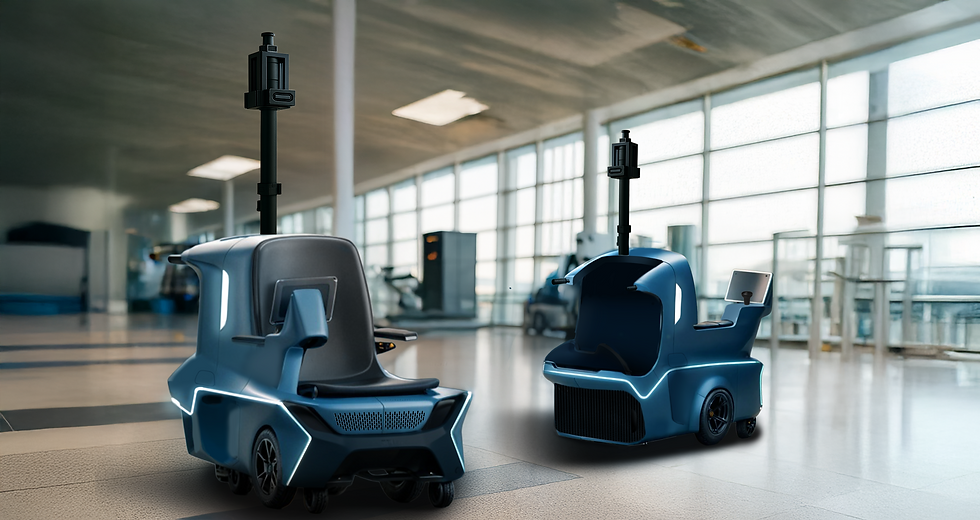
Our OmniSuite platform combines deterministic navigation frameworks, runtime supervision, autonomous recovery capabilities, and carefully selected machine-learning components to support mission-critical autonomous mobility.
By focusing on architecture rather than simply compute power, Cyberworks helps OEMs deploy autonomous systems that are designed to operate safely and reliably in real-world environments.
Comments